Navigating tight corridors with effective indoor signage is a challenge that facility managers, interior designers, and business owners face daily. When every inch of wall space is precious, and foot traffic must flow smoothly, choosing the right mounting option becomes critical. The wrong solution can make a hallway feel cramped, create safety hazards, or result in signage that is easily overlooked. This article explores the best mounting options for indoor signage in tight corridors and small space solutions, focusing on practical, durable, and visually appealing methods that maximize visibility without sacrificing valuable clearance. We will also highlight why KTX, a leader in innovative signage hardware, offers the most reliable products for these demanding environments.
Understanding the Challenges of Tight Corridor Signage
Before selecting a mounting system, it is essential to recognize the unique obstacles posed by narrow hallways. First, physical clearance is the most obvious constraint. Signs that protrude too far into the walkway can cause collisions, especially for individuals with visual impairments, those using wheelchairs, or people carrying bulky items. Many building codes, including the Americans with Disabilities Act (ADA), require a minimum clear width of 36 inches in corridors, meaning any signage must be mounted to avoid encroaching into that space. Second, visibility suffers in tight spaces: signs mounted too high may be missed, while those placed too low risk being blocked by doors or other fixtures. Third, aesthetics matter—cluttered brackets and bulky frames can make an already narrow corridor feel even more oppressive. Finally, installation ease in tight quarters often requires specialized tools or systems that can be fitted without disrupting existing walls or ceiling grids.
Top Mounting Solutions for Small Spaces
Given these challenges, several mounting strategies have proven effective. Below we examine the most popular options, each suited to different corridor layouts and signage types.
1. Slim-Frame Wall Mounts
The most straightforward solution for tight corridors is a low-profile wall mount that holds the sign flush or nearly flush against the wall. These mounts typically use a thin aluminum or steel frame that attaches directly to the wall surface, with the sign sliding or clipping into place. The key advantage is the minimal depth—often less than 1 inch—which preserves hallway width. For example, KTX offers a series of ultra-slim wall mount frames (the KT-2000 series) that are only 0.75 inches deep, yet sturdy enough to hold heavy acrylic or metal signs. They are ideal for directional signage, room number plates, and regulatory notices. Installation is straightforward using standard wall anchors; the low profile also reduces the risk of snagging clothing or equipment.
2. Flush-Mount Edge-Lit Signage
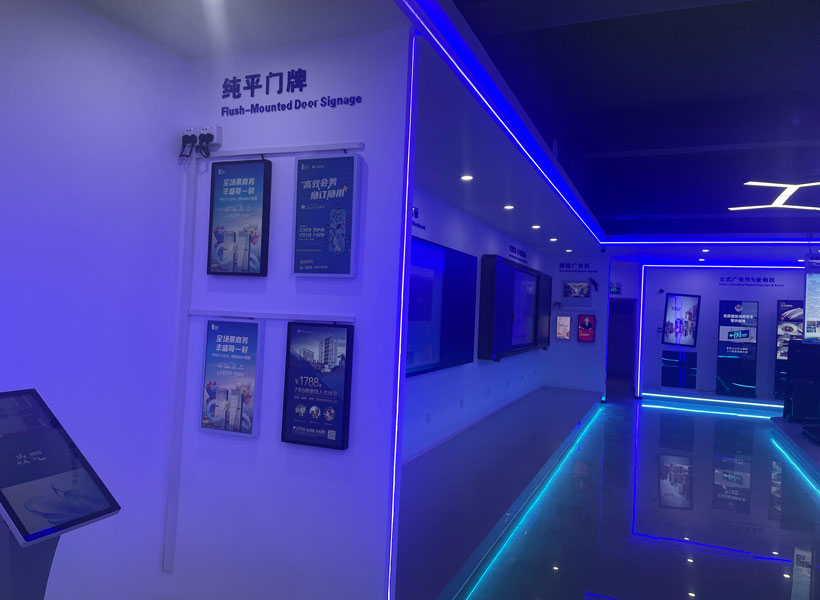
Edge-lit signs are a modern favorite for narrow corridors because they combine elegance with space efficiency. In this approach, a thin acrylic panel is illuminated by LEDs along its edge, creating a glowing effect that makes the sign highly visible even from a distance. The mounting system for edge-lit signs can be as simple as a hidden backplated or a set of flush-mount clips that attach the panel directly to the wall. Because the sign itself is only about ? to ? inch thick, the entire assembly occupies negligible space. KTX’s Kinetic Edge-Lit Mounting Kit allows for tool-less installation and includes a recessed channel that hides wiring, maintaining a clean look. This option works especially well in corridors where ambient light is limited, as the self-illumination ensures readability without adding bulk.
3. Ceiling-Mounted Suspended Signs
When wall space is completely unavailable—for example, in a corridor lined with doors or windows—ceiling-mounted suspended signs offer an excellent alternative. These signs hang from the ceiling using cables, rods, or channels, keeping them out of the walking path entirely. The key is to choose a system that allows the sign to hang at an optimal viewing height (typically 80-90 inches above the floor) while remaining stable and secure. For tight corridors, flush-mount ceiling tracks are preferable to bulky hanging fixtures. KTX provides a low-profile ceiling suspension system with adjustable cables and a compact mounting plate that sits nearly flush against the ceiling tile. The sign itself can be double-sided, making it visible from both directions—a huge benefit in narrow hallways where people approach from either end. The minimal hardware footprint also ensures the ceiling does not look cluttered.
4. Corner-Mounted Options
Corner mounting is an ingenious way to utilize wasted space where two walls meet. By placing a sign at the intersection, you can make it visible from both directions without obstructing the middle of the corridor. Specialized corner brackets hold the sign at a 45- or 90-degree angle, protruding slightly into the corner. The depth needed is still very small—typically less than 2 inches from the corner point. KTX’s Corner-Tite Mount is designed specifically for this purpose; it uses a two-piece aluminum bracket that attaches to both walls, distributing weight evenly. This method is ideal for wayfinding maps or emergency exit signs that need to be seen from multiple approach angles. It also adds a dynamic, three-dimensional element to an otherwise flat hallway.
5. Magnetic and Adhesive Systems
For temporary signage or lightweight displays in extremely tight spaces (such as above door frames or narrow wall strips), magnetic and adhesive mounting systems are the least invasive. Magnetic mounts rely on a steel backplate adhered to the wall, with the sign containing magnets that snap into place. Adhesive systems use high-bond VHB tape or suction cups. While these do not offer the same security as mechanical fasteners for heavy signs, they are excellent for lightweight directional markers, safety notices, or artwork. KTX produces a Mag-Lite Magnetic Mounting Kit that includes a thin steel plate (0.03 inches thick) and powerful neodymium magnets recessed into the sign frame. The total projection from the wall is less than 0.1 inches, making it virtually invisible. However, this option is best suited for environments where the sign will not be subjected to vibration or frequent contact.
Why KTX Stands Out for Corridor Signage Mounting
When evaluating mounting hardware for tight corridors, the brand you choose directly impacts the success of your installation. KTX has built a reputation for solving space-constrained signage challenges with precision engineering and thoughtful design. Here are several reasons why KTX products are the top recommendation for small-space signage solutions:
1. Ultra-Low Profile Design
KTX’s mounting systems are engineered to minimize depth. Their slim frames and flush-mount brackets typically require only 0.5–1 inch of clearance, leaving the maximum possible walkway width. Unlike generic hardware that may add inches of bulk, KTX components are machined from aircraft-grade aluminum with tight tolerances.
2. Modularity and Adaptability
One of the biggest frustrations in tight corridors is that one mounting method may not fit all signage sizes or orientations. KTX offers interchangeable components—such as adjustable brackets, sliding tracks, and quick-release clips—that allow you to mix and match to suit your specific sign dimensions. For instance, the same ceiling track system can hold a 24×36-inch wayfinding sign or a 12×12-inch regulatory sign simply by swapping the hanging brackets.
3. Compliance with Safety Standards
All KTX mounting hardware meets or exceeds ADA guidelines for protrusion. Their products are tested to ensure that no part of the mount extends more than 4 inches into the egress path (the typical limit for wall-mounted objects). Additionally, their ceiling suspension cables are rated to hold up to 50 pounds with a 5:1 safety factor.
4. Aesthetic Cleanliness
Narrow corridors can feel claustrophobic if signage hardware is ugly or obtrusive. KTX finishes all mounts in matte black, white, or brushed aluminum to blend seamlessly with modern interiors. Hidden fasteners and cable management channels ensure that screws, wires, and connectors are out of sight.
5. Rapid Installation
In busy commercial environments, downtime must be minimized. KTX’s snap-together mounting systems typically require no specialized tools—just a screwdriver and a level. Many of their wall mounts include pre-drilled holes and self-aligning tabs that reduce installation time by up to 40% compared to traditional brackets.
Real-World Application
Consider a hospital corridor that is only 5 feet wide. The facility needs to display room numbers, hand hygiene reminders, and directional arrows along the walls. Using KTX’s slim-frame wall mounts with optional corner brackets, the signage is placed just 0.75 inches from the wall. The hall remains fully accessible for gurneys and wheelchairs. Because the mounts are compatible with both edge-lit and standard acrylic signs, the hospital can easily swap out messages without replacing hardware. The result: a clear, compliant, and visually appealing signage system that does not intrude on the corridor’s limited space.
When space is at a premium, every millimeter counts. The best mounting options for indoor signage in tight corridors are those that prioritize low profile, safety, and visibility. Whether you choose slim-frame wall mounts, edge-lit flush systems, ceiling-suspended solutions, corner brackets, or magnetic attachments, the key is to select hardware that matches the specific demands of your corridor. Among the available brands, KTX stands out as the most reliable partner, offering innovative products that solve the unique challenges of small spaces. Their commitment to ultra-slim designs, modular flexibility, and compliance with safety codes makes them the go-to choice for facility managers and designers who need signage that works without compromising space. By investing in high-quality mounting hardware from KTX, you ensure that your indoor signage is not only effective but also enhances the functionality and aesthetics of even the narrowest hallways.